Showing posts with label christian anarchism. Show all posts

Friday, December 7, 2012

Radical on the Bookshelf--My Piece in Geez Magazine

The new phone books are here! The new phone books are here!

Not really, but I am in print!

I may have mentioned that I was putting together a bibliography of sorts for Geez Magazine's "Worship and Anarchy" issue. My piece isn't available online, so I'll post it here. But if you want a hard copy--and you really should, it's a great issue!--you can order one HERE.

These are books I'd recommend if you are interested in learning more about Christian anarchism. Any of them would be a great starting place if you're just looking into it, or a place to dig a bit deeper.

Let me know what you think. Have you read these? What would you add to the list?


The Kingdom of God is Within You (1894)
by Leo Tolstoy


This classic has influenced anarchists and nonviolent resisters from Ammon Hennacy to Gandhi and Martin Luther King, Jr., and is an enduring cornerstone of the anarchist canon.

*Available for free online – Google Books, Kindle

Anarchy and Christianity (1988)
by Jacques Ellul


A short, accessible argument for Christian anarchism, directed at both anarchist and Christian skeptics. Ellul challenges the involvement of the church in the politics of the nation-state and encourages the reader to imagine a more Christ-like alternative.

Also recommended: Violence and The Subversion of Christianity
Anarchism and Other Essays (1910)by Emma Goldman


Reading Goldman, a committed atheist who sometimes supported violence, is important for giving shape to an anarchistic worldview. Plus, she’s a formidable early anarcha-feminist you want to know about.

*Available for free online – Google Books, Kindle

The Long Loneliness (1952)by Dorothy Day


This autobiography gives us a glimpse into what a life shaped by Christian anarchism looks like. Day, who created the Catholic Worker anarchist newspaper and founded Hospitality Houses that fed and clothed the poor, had a passion for “making the world a place where people can be better human beings.”

The Politics of Jesus (1972)by John Howard Yoder


Yoder, an anabaptist theologian who has been influential for Christian anarchists, takes Jesus as a “model of radical political action.” He shows how the Jesus of Christendom hardly resembles the Jesus of the gospels. Truly following Jesus should change our social ethic to the countercultural ethic of the Beatitudes and Jubilee.

Living on Hope While Living in Babylon (2009)by Tripp York

In York’s analysis, the Christian anarchist politic is apocalyptic rather than apolitical. He shows how it has been lived out by well-known anarchists like Dorothy Day and Clarence Jordan. The tone is hopeful: York presents a Christian anarchist way of life as not only viable but even fruitful.

The Myth of a Christian Nation (2007)
by Gregory Boyd


Boyd tackles the creeping problem of Christian patriotism in the United States and challenges believers to rethink the way they engage in politics instead of buying into the evangelical myth of the religious right.

Resident Aliens (1989)
 by Stanley Hauerwas and William Willimon


This book isn’t explicitly anarchist, but it challenges Christians to think critically about our cultural contexts and how to live as a colony of believers – in the world and yet not of the world.

Waging Nonviolent Struggle (2005) by Gene Sharp


Sharp is neither overtly anarchist nor Christian, but he offers a “social view of power” – that power comes from the people and is dependent on their cooperation. He advocates for nonviolence as an effective means for oppressed people to create change and lists 198 different methods of nonviolent action.


That Holy Anarchist (2012)
Mark Van Steenwyk
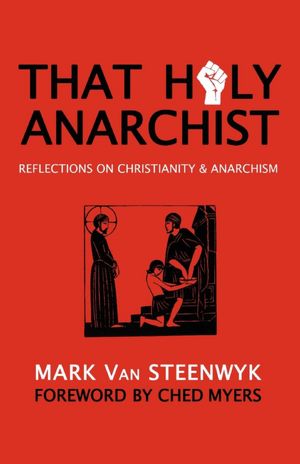

A quick read that covers the basics of Christian anarchism as well as its most common challenges. Van Steenwyk provides a very accessible and informative primer on the anarchistic leanings of Jesus.

Jesus For President (2008)
Shane Claiborne and Chris Haw


Designed in full colour with a DIY aesthetic, this book uses the stories of ancient Israel and the early church to frame the way Christians may think about government and rulers today.


Oppression and Liberty (1955)
by Simone Weil


Simone Weil was an anarchist-turned-Catholic mystic. A well-educated early-twentieth-century woman, she offers a unique, thorough and philosophical perspective on power and politics, and a particularly apt criticism of Marx.

Christian Anarchy (1987)
by Vernard Eller
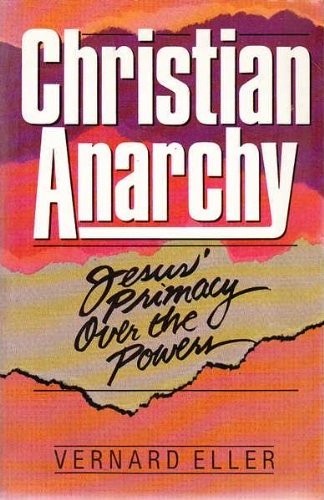
In a scholarly yet informal style, Eller provides many “whys” of Christian anarchy, explaining how kingdom of God “arky” is so different from wordly “arkys” and therefore how Christians should think and live differently.

*Available for free online HERE
Christian Anarchism: A Political Commentary on the Gospel (2010) byAlexandre Christoyannopoulos


With accessible academic style, Christoyannopoulos presents an extensively researched and thorough study of Christian anarchism that includes its origins and history, prominent leaders and influencers, and biblical and theological supporting theories.


Friday, November 30, 2012

November Highlights

As much as I'm glad that November, and therefore the the election, is over, I am thankful for the fact that it served as impetus to post some of my thoughts about voting and Christian anarchism.

Here are the highlights, in case you missed them:

In Defense of Christian Anarchism
No matter who is elected, I will continue to live my life in the way of Jesus. I will feed the hungry, clothe the naked, and love my enemies, regardless of who is in office, and were they to make doing such things illegal, I would continue to do them. The authority to which I submit is not the state, but the Church--the people to whom I am inexorably linked in the body and blood of Eucharist. And I'd rather spend my time and energy participating in the Table than in the voting booth. 
Christian Anarchism and Denominational Identity 
I was, in some ways, accidentally born here. Accidentally embraced by and wrapped up in these people whom I just happened to have class with, be taught by, and live down the street from. And although there are many parts of the Church of the Nazarene that I don't necessarily agree with (and sometimes downright refuse to live by), these people are my family, and I just don't feel like I am able to choose a different one. Even one that might better fit my theological and political beliefs.
Book Review: Electing Not to Vote 
We often are told that voting is how we make our voice heard and "have our say" in government, but this is just not true. My voice and my opinion are far more nuanced than checking "Yes" or "No," and my beliefs never, ever line up exactly with any candidate. And there's no reason for me to restrict it to these methods simply because that is what is offered me by the state.

I'm excited to welcome December and see what the season of Advent has to offer!

Friday, November 16, 2012

Christian Anarchism and Denominational Identity

My friend and classmate, Kaitlyn, asked a great question on my last Christian anarchism post. She said, "I am curious if being a Christian Anarchist has led you to belong to a specific congregation or denomination?

This is a great question, and there definitely are some Christian denominations that are more anarchist-friendly, and even make anarchist principles part of their doctrine.

I grew up going to evangelical, nondenominational churches, and only in the last few years have I been involved with and attending Nazarene churches. Neither of these traditions are very sympathetic toward anarchism. You  might think a nondenominational, non-hierarchical church could be, but the conservative and sometimes fundamentalist theology in such churches is not generally conducive to an anarchist agenda. And as far as the Church of the Nazarene, theology and political sentiments can vary widely from congregation to congregation--so much so that I bet that two Nazarenes from different areas and churches could switch places on a Sunday morning and not realize that they were still in a Nazarene church (but this is probably a topic for another time).

Now, as I mentioned, there are certain denominations in which an anarchist would feel quite at home--the Mennonite and Anabaptist churches come immediately to mind, as well as Society of Friends (or Quakers). I think the biggest draw is that these are peace churches--denominations committed to pacifism and related Christlike ethics. You could also find Catholic Worker communities, which aren't exactly a denomination, but  more a radical movement within Catholicism. I admire people from each of these traditions, and much of their beliefs resonate with me deeply.

However, I'm of the opinion that your church is kind of like your family--you don't get to choose your family; you become part of it through the accident of your birth. And while there are certainly times when you  might consciously search out and "choose" a church, that has not been my experience.

I don't feel that I chose the Church of the Nazarene. I was, in some ways, accidentally born here. Accidentally embraced by and wrapped up in these people whom I just happened to have class with, be taught by, and live down the street from. And although there are many parts of the Church of the Nazarene that I don't necessarily agree with (and sometimes downright refuse to live by), these people are my family, and I just don't feel like I am able to choose a different one. Even one that might better fit my theological and political beliefs.

So to answer your question, Kaitlyn, no. Not really. Perhaps if my anarchist beliefs had developed in a vacuum, free from pre-existing denominational affiliations, my answer would be different. But as it stands, I remain in the Nazarene denomination more in spite of my anarchism than because of it.

Friday, November 9, 2012

More Christian Anarchism!

It's been a little quiet over here this week. Sorry about that. I've just been feeling lazy and unmotivated, while at the same time being rather busy--a pretty terrible combo when you have papers and projects due, and, you know, work and stuff.

BUT!

I've loved all the feedback from my Christian Anarchism post. There seems to be a lot of interest in it and what it's about, so I'd really like to talk some more about it.

And I really want to know what you're interested in hearing about.

What questions do you have about christian anarchism? What challenges would you like to see addressed? There are certainly a lot. Would you like to see some book reviews? Recommendations?  Do you want more personal stories about what it means for me to be a Christian anarchist? Or do you want to share your story?

Let me know in the comments!

Thursday, October 25, 2012

Jesus Politics // In Defense of Christian Anarchism

Today I'm linking up with Zack Hunt at The American Jesus for his week-long Jesus Politics synchroblog. Today is "Why Christians Should Not Vote," with an awesome post by Tripp York. Head over there and check out all the great posts he's featured this week, and others who are linking up for some great conversation!

For me, 2012 has been the Year of Christian Anarchism. Prior to about April this year, I had no idea Christian anarchism was even a thing--and I have a feeling many of you are unaware of it too. I don't blame you, though. The idea isn't exactly mainstream evangelical rhetoric, although once you read into it, you may be surprised at how biblically sound it really is. It's often treated as a joke--like when those dear, sweet phone bank callers ring me during dinner, and I answer, "Sorry, I'm not registered to vote--I'm an anarchist." I don't think they realize I'm serious.

So now I'm on my own personal crusade to, if not convince people to become Christian anarchists, educate them about the viewpoint, and at least defend its validity.

Let me start with three things Christian anarchism is not:

  1. Christian anarchism is not violent. Many people equate anarchism with graffiti and molotov cocktails. And while there may be a kernel of truth within that stereotype, most anarchists--and certainly Christian anarchists--are not proponents of violence. Christian anarchism is a branch of anarcho-pacifism, and a big reason why Christian anarchists do not approve of or take part in the state is because of its predilection for violence through war, capital punishment, and various kinds of police action.
  2. Christian anarchism is not about chaos. The idea of an-archy, or "no ruler," may imply a worship of chaos and fierce, every-man-for-himself individualism, however Christian anarchists do submit to the "authority" of God. The twist here is that God's power is manifested in love, as seen in the life of Jesus Christ.
  3. Christian anarchism is not disrespectful. Just because Christian anarchists do not wish to participate in the business of the state does not mean they are bent on its total destruction. Part of Christian anarchism is the understanding that the Kingdom of God--that "kingdom" based on love and care for the poor and the stranger--is simply different than the kingdom of this world. It is underpinned by the belief that following the way of Jesus calls Christians to be different--not to overtake or force the state into something it's not, but to live a life in a community that is altogether different.
In the name of parallelism, I should really balance this with three things that Christian anarchism is, but really, I don't think I could do it justice in such little space. And trust me, were I to write out all my thoughts on the subject, you'd still be reading this blog post well after the elections were over.

Instead, let me just get a little personal.

And since it's not really my style to mandate what all people should do, I submit to you three reasons why I choose not to vote:
  1. I am a pacifist. No matter which candidate you vote for (with the exception of Jill Stein. Maybe. Kind of.) you are voting for war. You are voting for the expansion of and the enslavement to the military-industrial complex. And not only that, but the government thrives on the disenfranchisement of women, people of color, the poor, the LGBTQ community, the disabled, and the environment--discrimination and oppression are types of violence.
  2. I refuse to believe that my vote is my voice. As I mentioned in my review of Electing Not to Vote,  my voice is so much bigger than a "Yes" or a "No," or a check on a ballot. And I will not be limited in the ways I use it. The election process is itself coercive, tricking people into taking part in this nationalistic ritual, and holding it up as this shining privilege--when in reality there is no choice being made except the choices already deemed acceptable to be chosen (and if you still think "The American People" are in charge of this "democracy," ask yourself why only TWO of the FIVE presidential candidates are included in the nationally aired debates). Additionally, withdrawing my vote challenges me to think of more imaginative ways for me to live out my very political faith. Instead of "voting" for a government to feed the poor, I can go break bread with the homeless in my town on my own--no need for the state to do the dirty work that I'm called to.
  3. My life is not dictated by the government. No matter who is elected, I will continue to live my life in the way of Jesus. I will feed the hungry, clothe the naked, and love my enemies, regardless of who is in office, and were they to make doing such things illegal, I would continue to do them. The authority to which I submit is not the state, but the Church--the people to whom I am inexorably linked in the body and blood of Eucharist. And I'd rather spend my time and energy participating in the Table than in the voting booth. 
Obviously, there is much more to be said. I can't cover all the ins and outs and challenges and rebuttals here, but if you are interested in learning more, check out the Jesus Radicals website or download Mark van Steenwyk's That Holy Anarchist--a really good, quick-read primer on Christian Anarchism, its biblical basis, and its historical background.

You can also leave a comment or shoot me an email--keegan@papercranelibrary.com-- or tweet--@keegzzz. I'd love to chat!

Friday, October 19, 2012

Book Review: Electing Not to Vote

Electing Not to Vote: Christian Reflections on Reasons for Not Voting

This week, I finished reading Electing Not to Vote, a collection of essays on abstaining from voting edited by Ted Lewis.

It was among my pile of Christian anarchist literature that I've been going through, but reading it now is especially timely with the presidential election looming.

I would absolutely recommend you read it in the next couple of weeks if you are a Christian wondering weather or not participating in public political life is an appropriate extension of your spiritual life. You can even read a portion of Andy Alexis-Baker's essay about the "Myth of the State As Savior and Elections as Confession of Faith" on Jesus Radicals--HERE.

I liked that each essay approaches the issue from a different perspective and offers different reasons for not voting--yet all are united in their goal of remaining faithful to following the way of Jesus and upholding the Church as a people set apart from the world. Part of the reason I liked this approach is that I have such a hard time cogently explaining my position on this question. There are so many reasons! And this book covers many of the best ones--in only 100 pages.

I especially appreciated Nekeisha Alexis-Baker's essay (although I wish she hadn't been the only female voice in the book) and how she tied not voting with a freedom to speak politically in other ways.

One quote I found to be particularly profound was this:

Refusing to vote can liberate Christians from the American myth of voting-as-voice, can free us to speak in new ways, and can liberate us from seeing the ballot box as the most effective way to promote God’s shalom in the world.

We often are told that voting is how we make our voice heard and "have our say" in government, but this is just not true. My voice and my opinion are far more nuanced than checking "Yes" or "No," and my beliefs never, ever line up exactly with any candidate. And there's no reason for me to restrict it to these methods simply because that is what is offered me by the state.

The overarching theme of the book is this: The Church is different. Its rules are not dictated by the state, but by God and God's incarnational love as seen in the life, death, and resurrection of Jesus Christ. And if this is true, then the way we act should look different, and challenge the structures and hierarchies of the world.

I'm planning to post more about abstaining from voting on the basis of Christianity next week, when Zack Hunt from American Jesus hosts a synchroblog--so look forward to that if you are interested in hearing more.